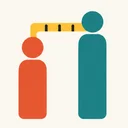
How to measure your step length
Mark out a known distance, walk it at your normal pace and count your steps. The distance divided by the steps is your step length, the number Fitbit and Garmin ask for as “stride length”. The calculator below does the sums, and gives two steps as well, for anyone who means a stride from one foot back to the same foot.
Your step and stride
Example walk: type your own over it.
- Your step is 30 in (76 cm): the number to type into Fitbit or Garmin as your stride length.
- Two steps, one with each foot, cover 60 in (152 cm).
- That is about 2,112 steps to a mile (1,312 to a kilometer).
Measure your walk
Use a running track, a long hallway or a tape along the floor, long enough for at least 20 steps, as Fitbit asks; on a longer walk a miscounted step matters less. Start walking a few steps before the first mark so you reach your normal pace, count every foot that lands between the two marks, and walk it twice to check the count.
Walk the way you will walk with the tracker: a brisk walk takes longer steps than a stroll, and a run longer again. Trackers keep a walking and a running length apart for that reason.
Step or stride?
A step runs from one heel to the other foot’s heel. Some writers call that a stride; others keep “stride” for two steps, from one heel back to the same heel.
Fitness trackers mean one step. Fitbit works out distance as steps times stride length, and Garmin’s Custom Stride Length setting takes a distance and the steps it took, then works out your step length. Type your step into either.
Fitbit: how your device calculates distance · Garmin: Custom Stride Length
Why not from your height
Fitbit sets your stride length from your height and sex until you change it, and says to measure it if your legs are longer or shorter than average. Pace, leg length and the ground all change a step, so a measured walk gives the number to trust.
The next useful step
- How to measure your height at home, step by step
- How to measure your wingspan, and how it compares with your height
How the charts work explains the shared scale, source precision and custom inputs.