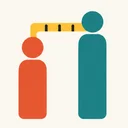
How to measure your wingspan
Stand with your back to a wall and your arms straight out to the sides at shoulder height, level with the floor, and measure from the tip of one middle finger to the tip of the other. For most adults the span is close to their height; for men it is often a little longer.
Your wingspan against your height
Example figures: type your own over them.
Your arm span is 2 in (5.1 cm) longer than your height: an ape index of +2 in, a ratio of 1.03.
For comparison, the average man in the US Army’s 2012 survey of its soldiers had an arm span of 71.4 in and a height of 69.1 in: about 2.3 in longer, a ratio of 1.03 (Wikipedia, Ape index).
Measure it at home
With a helper or a wall you can mark: stand with your back to the wall, arms straight out and level, fingers stretched. Mark the wall at the tip of each middle finger, step away and measure between the marks.
On your own, measure your half span instead: from the notch at the top of your breastbone to the tip of your middle finger, with one arm stretched out level to the side, then double it. Clinicians measure the half span the same way when someone cannot stand up straight to be measured.
Wingspan against height
Wingspan minus height is what climbers and basketball scouts call the ape index; some write it as the span divided by the height. A 6 ft 0 in span on a 5 ft 10 in person is an ape index of +2 in, or a ratio of 1.03.
A span equal to the height is the proportion Vitruvius described about 2,000 years ago. Men measured today often come out a little longer: in the US Army’s 2012 survey, the average soldier’s span was about 2.3 in longer than his height.
Reach in boxing and MMA
Fight cards list a fighter’s reach, which is the same fingertip-to-fingertip measurement. Sonny Liston stood 6 ft 1 in with a 7 ft 0 in reach; Jon Jones stands 6 ft 4 in with a 7 ft 0.5 in reach.
Why the drawings show height only
The drawings on this site scale standing height. A wingspan is never worked out from a height here: people of the same height can differ by several inches across the arms.
Try the same example
Draw Jon Jones beside the average man. The names, units and values carry into the editable chart.
For the arithmetic alone, use the height difference calculator. For a different unit, use the height converter.
The next useful step
How the charts work explains the shared scale, source precision and custom inputs.